| Local 2822: Hennepin County Clerical and Related |
Labor Lunch: Strikes Recap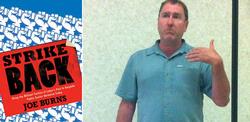
Author Joe Burns on strikes
By Sarah Sosa A shorter version of this article appeared in the December issue of A New Voice A group of 40+ Hennepin County workers gathered in the Government Center Auditorium on a brisk Wednesday afternoon to hear their fellow union activists describe their experience of strikes in their workplace. The panel of speakers was AFSCME Local 552 Vice President and probation officer Tim Turentine, President of AFSCME Local 3800 clerical workers at the U of MN Cherenne Horazuk, AFSCME Council 5 Metro Field Director Joyce Carlson and local author and labor lawyer Joe Burns. Each speaker outlined the issues in their workplaces that led up to their group’s decision to engage in strike tactics as well as the challenges and victories they encountered along the way. The reason we as the Education, Engagement and Outreach Committee decided to focus around the topic of the strike is because we felt the rich history of labor’s most effective militant tactic is an important story to share with our never employees as well as those not so new who would rather not think about things getting so bad that a strike would be considered. The unfortunate truth is that things could always get worse especially when we live in a time where unions are under attack by our country’s governing bodies (Supreme Court) and corporate business interests alike. Many members of the EE&O Committee were inspired by the book Strike Back: Using the Militant Tactics of Labor’s Past to Reignite Public Sector Unionism Today, which is the second book by author and panelist Joe Burns. We wanted to invite him to speak to Hennepin County workers at this event because he has a very thorough yet approachable way of speaking on labor’s history particularly in the public sector. Many of the lessons he writes about were mentioned at the event, and with history repeating itself all too often, his words serve as a cautionary tale. One needs only to look to our neighbor Wisconsin to see how Governor Scott Walker has decimated union rights for public employees. Where AFSCME locals could once rely on the legal pillars of a collective bargaining agreement, union leaders now have to get out in the workplace and deal with issues on the shop floor. According to Marty Beil, director of the Wisconsin State Employees Union, AFSCME Council 24, ‘issues with work rules like these were handled though grievance procedures. Now we talk a lot with our local union and our leadership to do direct action, because that’s really the only effective tool that we have left (Burns, 57).” This could be our fate at Hennepin County if we don’t lay the ground work now and make sure we have an effective communication network between members and local leaders to address those festering issues at the various worksites spread throughout the County. Furthermore, we must trust each other as union members first and coworkers second. This was touched on at the Labor Lunch and it stayed with me because too often I hear folks in the workplace ask about the legality of whatever workplace issues they may be experiencing that day. Although our contract was fought for and we should not take it for granted, it is a paper tiger when there are no workers willing to stand up for its integrity. Too often our union’s culture is one of collaborating with management to get some resolution on behalf of our coworkers who are not in the room or part of the process. Panelist and author Joe Burns would argue that this approach undercuts the potential strength of labor unions as it fails to utilize our most powerful tool—member driven direct action. Those who were fortunate enough to hear him speak know that he comes from a place of great experience and research in the labor movement when he says, “If labor allows management to define its concerns, the outcome will be an uninspired and powerless labor movement. It is only when organizers push beyond the current legal constraints that public unionism can achieve its true potential. This is not just a matter of making political alliances, but of also challenging the management-inspired structure of bargaining that has been imposed upon the labor movement (Burns, 72).” |
  |
|
© American Federation of State, County and Municipal Employees, AFL-CIO. All rights reserved. Photographs and illustrations, as well as text, cannot be used without permission from AFSCME. |
Privacy Policy |
