| Local 2822: Hennepin County Clerical and Related |
Kidney Donor Gives a Piece of Her Heart, Too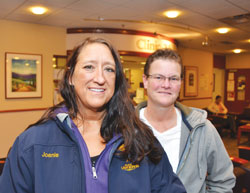
Joanie Kocher (front) and Local 9’s Kim Johnson.
Local 9’s Kim Johnson just had to disagree. She was about to donate a kidney, so was spending a whole day meeting with surgeons at the University of Minnesota Medical Center-Fairview. “They keep telling you: ‘You’re getting nothing from this’,” Johnson says. “They pound it into your head.” After all, selling a kidney is illegal in the United States. But Johnson told the surgeons: “You’re wrong. I am getting something from this: I’m giving somebody a chance to live.” So, on Oct. 17 – after more than a month of delays – Johnson donated her left kidney to Joanie Kocher, who is a friend of her roommate. From Day One, the transplant seemed to be a complete success. “It’s a good feeling – it’s fantastic,” says Johnson, the vice president of Local 9 and a 28-year Minneapolis employee in the water department. “The kidney is a rock star. Joanie started producing urine right away. They said they’d never seen a kidney work so quickly.” Kocher, of Waverly, had suffered from polycystic kidney disease for 15 years. Her condition began deteriorating four years ago, and she’s been on a transplant list ever since. Medical progress means donors do not have to be blood relatives and recipients do not have to wait for an organ donor to die before they can receive a kidney. In fact, transplants from living donors have a higher success rate. And compared with years of dialysis, transplants tend to keep recipients alive longer, with a better quality of life overall. After Johnson met Kocher in April, she decided to try to help. She went through six weeks of tests and interviews. The process finally verified that Johnson not only was a medical match to donate a kidney, but could handle the logistical and mental challenges as well. “I called her and said, ‘You want a piece of me?’” Johnson says. Making it all possible In Johnson’s case, she was not the only AFSCME member involved. Behind the scenes at the U of M Medical Center’s Transplant Center, Local 1164 members such as Tiffany West are part of a team that guides applicants through the process of donating a kidney, liver, or other organ. Living donors now account for about half the 200 kidney transplants that the center does each year. Potential donors such as Johnson first fill out an online questionnaire, which screens their physical and psychological health. West and a nurse coordinator personally process all applications. They handle the correspondence, lab results, logistics, and hand-holding that can make a transplant successful. Often, West says, donors apply with the hope of donating to a specific person. In Johnson’s case, that worked. One good deed leads to another Transplant programs make sure the donor’s medical expenses are fully covered. But for Johnson and other potential donors, the biggest challenge is covering the income they lose during recovery, which can take up to six weeks. State law requires one week of paid leave for bone marrow transplants. But it is silent on other types of organ donations. So Johnson applied for the city’s sick leave donation program – but was turned down. However, her department head intervened and guaranteed Johnson that she would get full pay during her recovery. That made the transplant possible. Johnson was scheduled to return to work in early December. Want to be a living donor? 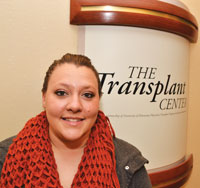
Local 1164’s Tiffany West handles much of the record-keeping in the donor process.
Fill out the online questionnaire. |
  |
|
© American Federation of State, County and Municipal Employees, AFL-CIO. All rights reserved. Photographs and illustrations, as well as text, cannot be used without permission from AFSCME. |
Privacy Policy |
