| Local 2822: Hennepin County Clerical and Related |
Private Group-Home Workers Win Breakthrough Organizing Victory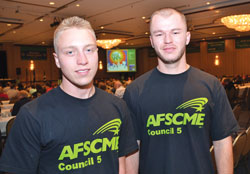
Cody Jakowski (left) and John Pietz led the union drive among workers at Stepping Stones for Living.
In an organizing drive that completely blind-sided their bosses, 173 workers at Stepping Stones for Living joined AFSCME in an overwhelming election victory. The new members work at 16 group homes in the Duluth area and at a day program in Hermantown. The workers provide residential and support services for adults with traumatic brain injury or mental illness. “Basically, we try to provide them the most normal life possible given the circumstances,” says John Pietz, a crisis float who helped lead the union drive. Many of Stepping Stones’ residents come from secure state sites such as Anoka Metro Regional Treatment Center. Council 5 represents hundreds of workers at such state facilities, but workers at Stepping Stones are the first members in private group homes in Minnesota. Pay dead-ends quickly Pietz and his friend and co-worker, Cody Jakowski, hope a union can help transform what are now demanding but low-paying, dead-end jobs. “That is a big thing,” Pietz says, “because we do have a pretty cool job: We get to help people.” Most of their co-workers are in their 20s. They’re trying to pay their way through college or starting families – and finding it impossible to make ends meet, Pietz says. Pay starts at $9.50 but caps out at $10.50 for most workers, they say. Training is minimal; the company can fire workers for any reason – or no reason; and turnover is sky high. Earlier this year, more than 40 percent of workers bailed in just five months. “If you could go sell T-shirts at American Eagle for the same money, which way are you going to go?” Pietz asks. High turnover ultimately hurts residents, they say, because it replaces consistency with instability. “We’re not working with machines,” Jakowski says. “We’re working with people who don’t have the ability to adapt, to build trust, the way you would.” Upheaval in homes makes it harder for residents to move toward independent living, he says. St. Louis County is filled with group homes like Stepping Stones, Pietz says. That makes it even more important to improve wages and working conditions in ways that turn the jobs into careers. Trusted leaders Jakowski and Pietz learned about AFSCME – and the advantages of a union job – through former co-worker Aaron Allen, who now is a member of DHS Local 1092 in Moose Lake. In leading the campaign at Stepping Stones, the duo had one key edge: As crisis staff, they regularly defuse situations at all 16 houses. Co-workers know them, see them in action, and trust them. So, when they stressed keeping the union drive secret, co-workers listened. “Not a peep,” Jakowski says. By the time workers filed for the election, 70 percent had signed union cards. But management hadn’t caught a whiff of what was going on. Company president Stephanie Ericksen scrambled to convince workers they were all “a big family.” But not everything was so kumbaya. In private, management shunned Jakowski and Pietz. Then, in a final attempt to undermine the election, management tried to reclassify the two of them and 13 co-workers as supervisors. That would have pulled them out of the bargaining unit. The move did stall the election. But in a ruling from the National Labor Relations Board, the company went 0 for 15. When the election finally took place in September, management lost again: More than 80 percent of workers voted to join AFSCME. The final vote: 94-22. Now, as they prepare to negotiate their first contract, Jakowski says: “I never expected us to be here. But this is the right thing to do. It’s right for current employees, and it’s right for everyone following us.” |
  |
|
© American Federation of State, County and Municipal Employees, AFL-CIO. All rights reserved. Photographs and illustrations, as well as text, cannot be used without permission from AFSCME. |
Privacy Policy |
